

Before you copy someone else’s itinerary, it helps to understand what actually makes a trip work for you.
That sounds obvious, but a surprising amount of travel advice skips this step entirely. Search for the “perfect” itinerary for almost any destination and you will usually find versions of the same route repeated again and again: the same cities, the same attractions, the same number of nights and the same assumptions about how quickly you should move.
Social media reinforces it. Pinterest, Instagram and Facebook keep surfacing the same photogenic places and must-do experiences until it starts to feel as though everyone is being funnelled toward the same trip.
Then someone posts an itinerary in a travel forum and asks whether it looks good. The opinions arrive immediately: too many nights here, not enough there, too much travel time, too many hotel changes, skip this city, add that island, you absolutely need to see this, you definitely do not need to see that.
But maybe that traveller likes moving every couple of days. Maybe a long train ride sounds relaxing rather than exhausting. Maybe the place everyone says to cut is the one they care about most.
It is almost impossible to assess someone else’s itinerary without knowing what matters to the person taking the trip. And often the traveller has not really asked themselves that question either.
There is no perfect itinerary without a perfect traveller
This became especially obvious while planning a long trip through Southeast Asia and Japan.
I spent a lot of time looking at suggested routes through countries like Thailand and Vietnam. Many were remarkably similar and often moved quickly from one major destination to another, packing in the places everyone was apparently supposed to see.
There is nothing inherently wrong with travelling that way. For a flexible solo backpacker who enjoys changing locations frequently and wants to see as much as possible, it could be exactly right. But the same itinerary might be exhausting for a family managing several people's energy levels, frustrating for someone who wants time to hike, or unnecessarily uncomfortable for someone who would happily spend more to avoid a 12-hour bus ride.
Even the alternatives can become overly prescriptive. Some family-travel advice seems to assume that travelling with children automatically means moving very slowly, avoiding difficult experiences and building the trip almost entirely around convenience. That can be just as limiting.
The useful question is not whether an itinerary is good.
It is whether it fits the people actually taking it.
PACE · STRUCTURE · POPULARITY · ENVIRONMENT · COMFORT · INDEPENDENCE · SPENDING
Travel styles are patterns, not rules
It can be useful to think in terms of travellers such as the Planner, Improviser, Collector, Slow Traveller, Explorer or Comfort-Seeker, but these are shorthand rather than identities. Most of us are several things at once, and the mix changes depending on the trip.
I lean strongly toward planning since I feel better knowing where I am sleeping and how I am moving between places, but I have learned that I enjoy the days themselves more when there is room for them to change.
I like seeing famous places when they are genuinely worth seeing, but I do not want to visit something simply because everyone else does. Though I enjoy cities, I find I increasingly need nature and quieter spaces to balance them. I appreciate comfort, but some of the experiences I remember most clearly are the ones that required effort.
None of those things need to fit neatly into a type. What matters is recognizing the patterns before they start making decisions for you.
The questions matter more than the labels
The most useful way to understand your travel style is not to decide which box you belong in. It is to notice where the tensions show up when you actually plan a trip.
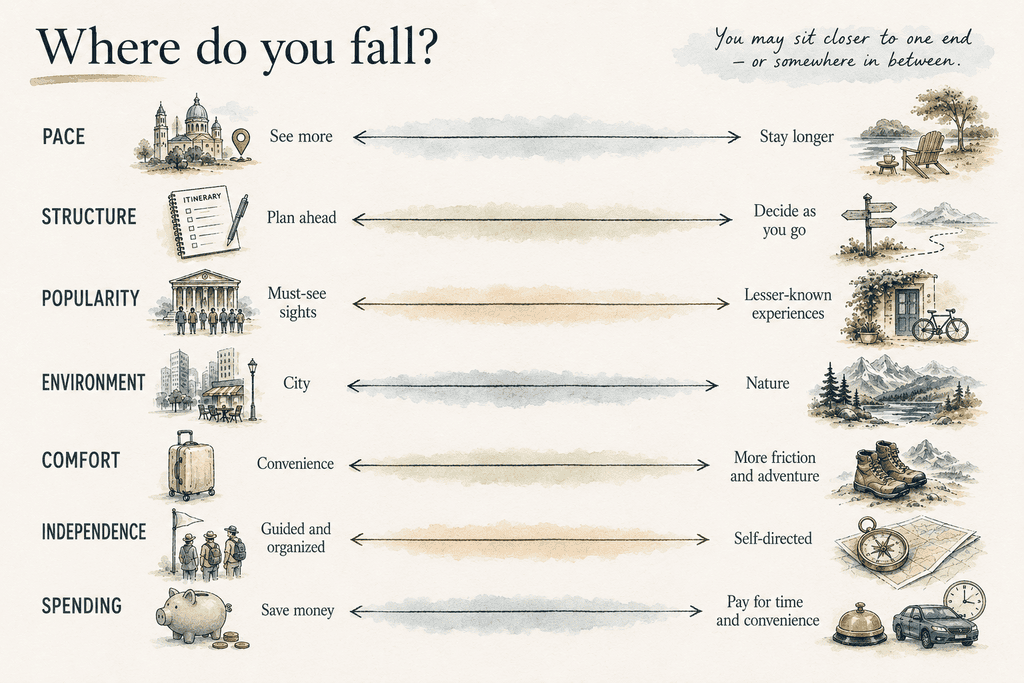
Pace: Do you enjoy changing places every couple of days, or do you only start enjoying somewhere once you have settled in? I have gradually moved toward a steady rhythm: longer stays of five or six nights mixed with shorter stops that have a clear purpose. When I was younger, I was much more inclined to collect places because I worried I might never return. Letting go of that feeling has made travel much less vulnerable to FOMO.
Structure: Which unresolved decisions feel exciting, and which quietly create stress? I like accommodation and major transportation arranged ahead of time, but I do not need every day scheduled. Travelling with children, one major activity is often enough of a framework. After that, we might see five more things — or spend the afternoon in the hotel pool. Both can make for a good day.
Popularity: Do you want the famous place because it genuinely interests you, or because you have seen it so many times that it now feels mandatory? Some attractions are popular because they are extraordinary. Others end up on an itinerary because repetition has slowly turned someone else’s priority into your own. The useful question is whether the experience itself matters enough to justify the crowds, time, cost or effort.
Then there are the trade-offs between city and nature, comfort and friction, independence and guided experiences, saving money and paying for convenience. These do not need a separate rule for every trip. They are simply prompts to notice what gives you energy and what drains it.

I still enjoy major cities, for example, but I experience them differently now. On repeat visits to somewhere like London, I am much more conscious of building in quieter neighbourhoods, parks or slower stretches rather than treating every day as a race between major sights.
And when money is involved, I no longer automatically assume the cheapest option is the smartest one. A flight can cost more than a 12-hour bus or train, but the real comparison also includes an entire travel day, fatigue and how everyone feels when they arrive. For another traveller, that long overland journey may be part of the adventure.
The point is not that one choice is better. It is knowing which trade-off you are actually making.
Independent travel does not mean refusing help
I generally prefer self-directed travel because I enjoy exploring an area on my own rather than automatically joining a tour.
But that preference is not a rule either. A well-done guided experience can reveal a piece of history, architecture or culture that I might otherwise have walked straight past. Some places are difficult to access independently, and sometimes handing the logistics to someone else is part of what makes an experience worthwhile.
The question I ask is not whether guided or independent travel is better. It is whether the tour is adding something I value.
Your travel style changes with context
One of the biggest problems with traveller “types” is the idea that you should behave the same way on every trip.
I do not.
Solo, I can change locations more frequently because I am only managing my own energy and luggage. Travelling with children changes the equation: there are several energy levels, appetites and moods to manage, and everyone rests differently.
Trip length matters too. On a short break during a demanding period at work, I may want a comfortable hotel, a beach and easy meals. Rest is the point.
Over several months, the calculation is different. There is room to build rest into the trip itself, so more adventure becomes appealing. A difficult transfer or active stretch matters less when it is balanced by slower days elsewhere. And being away for a long period does not mean the trip has to become another version of work; the travel itself still needs to be the priority.
Age, budget, destination and life stage can all shift the answer. Your travel style is useful precisely because it is allowed to change.
Your travel partners may answer differently
Understanding your own preferences becomes even more useful when you travel with other people.
Two people can want the same destination and imagine completely different trips once they arrive. One wants every hotel booked months ahead; another wants flexibility. One thinks paying for a taxi is wasteful. Another thinks it is an excellent trade for avoiding two buses and an hour of travel. One wants to see every major sight; another wants enough free time to discover something accidentally.
Those differences create tension when nobody has named what is underneath them.
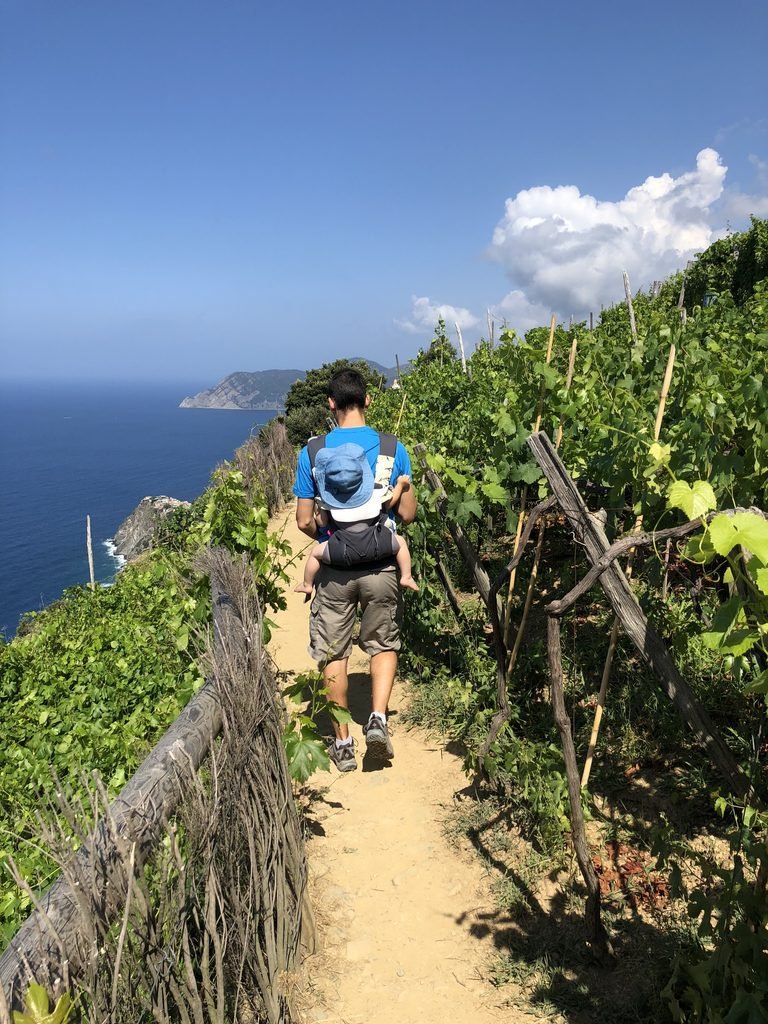
A real compromise in my own planning is simple: I feel better knowing where we are sleeping, while my husband values spontaneity. That becomes even more important when we are travelling with our kids. Booking accommodation and major transportation ahead of time means we are not trying to find somewhere to sleep on the fly when everyone is tired, hungry or simply done for the day. Leaving much of the daily schedule open still gives us the flexibility he values and lets us adjust to everyone's energy once we are there.
That conversation is easier once neither preference is treated as the correct way to travel.
Before you plan, ask yourself
You do not need to identify a perfect traveller type before booking a trip. You do need to notice your tendencies.
Ask yourself:
PACE
Do I feel energized by moving somewhere new every couple of days, or do I need time to settle in?
STRUCTURE
Which decisions make me uncomfortable if they are unresolved, and which ones do I enjoy making as I go?
POPULARITY
Which famous sights genuinely matter to me, and which ones are on my list mostly because I keep seeing them?
ENVIRONMENT
What mix of cities, nature, quiet and activity keeps me feeling balanced?
COMFORT
Which inconveniences feel like adventure, and which simply drain energy from the trip?
INDEPENDENCE
When do I enjoy figuring things out myself, and when would a guide genuinely add something?
SPENDING
Where am I happy to save, and where would I rather pay for time, comfort or convenience?
Then ask one more question:
Why?
That answer is usually more useful than the label.
The goal is not to become a different traveller
The point of understanding how you travel is not to correct yourself. It is to notice why some trips leave you energized while others leave you exhausted, why an itinerary that looks exciting on paper can feel miserable in practice, and why someone else's perfect trip might be completely wrong for you.
It can also help you change. Understanding my own tendency to collect experiences made it easier to loosen my grip on the idea that I had to see everything. I still like planning and I still want to experience a lot, but I am much more comfortable now leaving something undone.
Sometimes I will come back. Sometimes I won't. Either way, the value of the trip is not determined by how many things I managed to fit into it.
The discovery starts before you leave. The better you understand what you value, what drains you and what makes travel satisfying, the easier it becomes to build a trip that actually feels like yours.