


Twenty-six nights sounds like a lot of time in one country. In Thailand, it still was not enough to do everything we considered. That was never really the goal.
Thailand is the first stop on a much longer trip through Southeast Asia and Japan, and we wanted the beginning to do several things at once: help us recover from the flight from Canada, ease into travelling full-time as a family, experience some of northern Thailand, and still leave enough time for the islands and a slower pace.
The route we eventually settled on was:
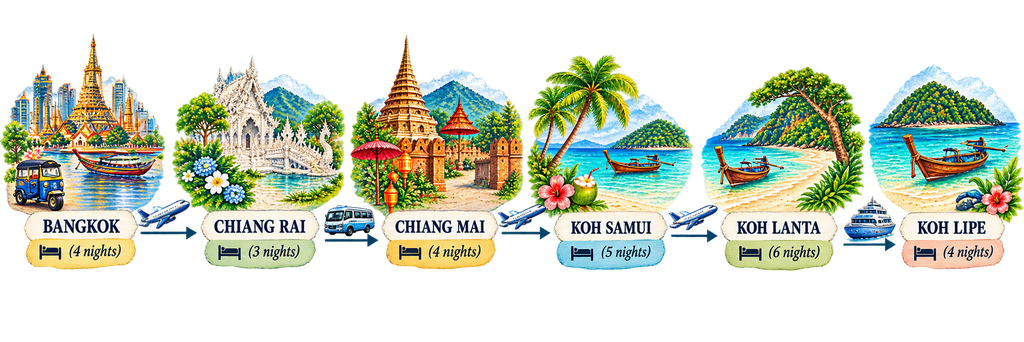
It is not the fastest route, the cheapest route or the route that sees the most places. It is the one that best matched what we wanted from this part of the trip.
Affiliate disclosure: This article contains affiliate links. If you book or buy through one of them, I may earn a commission at no additional cost to you. This does not affect the recommendations or comparisons in the article.
The quick decision
This is a planning article about one specific 26-night Thailand route. It is not meant to be a universal recommendation for how long you should spend in the country.
Best for...
Travellers who want a mix of culture, nature and islands without changing locations every couple of days.
Add more mainland time if...
National parks, historic sites and overland exploration matter more to you than long island stays.
Move faster if...
Frequent hotel changes energize you and seeing more places matters more than building in downtime.
Choose a different route if...
You are trying to minimize costs and prefer long buses, trains or ferries to paying more for domestic flights and shorter transfers.
Why Thailand became our first stop
Our original Southeast Asia route ran in almost the opposite direction. We initially thought we would fly into Singapore, travel north through Malaysia and southern Thailand, continue through Bangkok and northern Thailand, and then move toward Laos. Geographically, it looked tidy.
Then we started looking more closely at January weather. Singapore tends to be wetter in January than later in the winter, while January is a strong time for much of Thailand. That pushed us to reconsider the sequence entirely. Once we decided to reverse the route, the flight research changed too: instead of looking for ways into Singapore, we began looking at Bangkok.
Fortunately, Bangkok is a major Southeast Asian hub, so starting there did not create a problem. It did, however, mean rebuilding the Thailand route because our neat south-to-north progression no longer made much sense.
There were also some advantages to putting Thailand first. We wanted both the north and the islands, January allowed us to reach northern Thailand before the worst of the burning season, and beginning with a substantial amount of time in one country felt like a gentler way to start a very long family trip.
After a busy fall and holiday season at home, we also expect to need some actual rest. The islands became part of that plan rather than something tacked onto the end.
How we decided how many nights to give each place
There was no formula that said Bangkok gets four nights and Koh Lanta gets six, but there were a few principles we kept returning to.
PLANNING & RESEARCH
This route reflects our plans before travelling. We will update the site with firsthand experience once we have started our trip.
Arrival and departure days are not really full days. Packing, checking out, getting to an airport or ferry, transferring to the next place and settling in again all consume time and energy. Arrival days can still be good for walking around and getting oriented, but we do not count on them for major activities.
We also wanted to balance quicker stops with slower ones. We did not want the whole trip to feel like a cycle of packing, moving, unpacking and starting again.
The other rule I keep trying to use is roughly one substantial planned activity per day when travelling with the kids. If we do more, great. But if Doi Inthanon, an elephant sanctuary or a full-day boat trip is the main event, that is enough structure for the day. The rest can be a market, a walk, the hotel pool, homeschooling, an unplanned restaurant or simply doing less because everyone is tired.
It is the compromise between the planner part of me that wants to know where we are sleeping and how we are getting there, and the more flexible part of family travel that needs room to respond to how everyone is actually feeling.

Bangkok - 4 nights
LANDING ZONE
Bangkok is partly a destination and partly our landing zone.
Our flight arrives around 6:30 a.m. after a long journey from Canada, so four nights does not mean four energetic sightseeing days. Jet lag alone could determine how much we accomplish at the beginning.
We are interested in Bangkok for the food, temples, markets and city experience rather than nightlife. We also wanted enough time to keep the possibility of a day trip to Ayutthaya without making the rest of Bangkok feel compressed.
At one point, we considered travelling gradually north from Bangkok, potentially stopping around places such as Ayutthaya or Erawan Falls rather than flying onward. That would have given us more mainland Thailand and a more overland route, but it would also have meant more early hotel changes at exactly the point when we are adjusting to the time zone, language, culture and the reality of travelling together for several months.
Four nights gives us somewhere to land. If we are feeling energetic, we can do more. If jet lag hits hard, the itinerary can absorb it.

Chiang Rai - 3 nights
EASE INTO THE NORTH
Chiang Rai started as a one-night idea.
I already knew I did not want to visit it as a long day trip from Chiang Mai. That type of day could work for someone who wants to maximize sights and is comfortable spending hours in transit, but it did not fit the pace we were trying to establish with the kids.
Initially, the more obvious route was Bangkok → Chiang Mai, potentially using the overnight train as part of the experience. The problem came when I started working out how we would eventually get from northern Thailand to Koh Samui.
I was not interested in turning that transition into a 20-plus-hour overland journey. We would eventually need to fly south from Chiang Mai, and adding Chiang Rai as a quick side trip suddenly meant more backtracking and awkward flight timing.
Then I realized we could fly directly from Bangkok to Chiang Rai and continue overland to Chiang Mai afterward. That solved the route.
The third night came partly from accommodation research. The Riverie by Katathani kept standing out: a riverside resort close enough to Chiang Rai to explore the city, but with enough space and facilities that it could also function as somewhere to rest.
The temples are still the main reason Chiang Rai made the route. But three nights means we do not need to treat the city as a checklist. We can visit the temples, explore a little, let the kids enjoy the resort and simply recover if the first week of the trip has caught up with us.
Bangkok plus Chiang Rai gives us a full week to adjust before the pace picks up.

Chiang Mai - 4 nights
ACTIVITY BASE
The bus from Chiang Rai to Chiang Mai means our first day will already be partly consumed by moving. We also plan to leave Chiang Rai after a leisurely breakfast rather than treating the transfer as something that has to begin at dawn.
That leaves three full days in Chiang Mai, and we already have more than three things that interest us.
Doi Inthanon deserves its own day. So does an ethical elephant sanctuary if we find one that fits what we are looking for. I also want time to walk the Monk's Trail, potentially continuing toward Doi Suthep depending on how everyone feels.
Then there is Chiang Mai itself: the old city, temples, markets, food and perhaps a massage.
Four nights is therefore not particularly generous. It simply gives us enough time to avoid stacking a major excursion every day. If Doi Inthanon takes one day and the elephant experience takes another, I still want at least one day where the plan can be something as simple as exploring the city and seeing where we end up.
Why we are flying south instead of travelling overland
This is one of the clearest places where our own travel priorities shaped the itinerary.
From Chiang Mai, we are flying directly to Koh Samui. That is not the cheapest way to travel between northern Thailand and the islands. It is the option that buys us the most time and removes the most friction.
Paying for time
Flying directly from Chiang Mai to Koh Samui costs more than travelling overland, but it preserves a large amount of travel time and removes a significant amount of friction. For this trip, that trade-off was worth paying for.
On our date, the direct Bangkok Airways flight is scheduled around midday, and direct options are limited. We booked it early because we specifically wanted to avoid routing back through Bangkok and because island flights during January can be popular.
The comparison was not simply flight price versus bus or train price. It was also a comfortable daytime transfer versus potentially losing an entire day — or more — getting four people across the country.
For someone who enjoys overnight trains and long overland travel, that journey could be part of the experience. For us, this time, it was not. We were willing to spend more to get directly to the island and preserve that day for the trip itself.

Koh Samui - 5 nights
EASY ISLAND TRANSITION
From the beginning, we wanted at least one island in the Gulf of Thailand and more than one island experience overall. Koh Samui won partly because it is easy to reach by air and partly because it seemed to offer more variety than a purely beach-focused stay.
The island of Koh Tao appealed less because so much of its reputation centres on diving, which is not an activity the kids can realistically take part in yet. Finally, Koh Phangan looked interesting, but Samui seemed to offer a broader mix for this particular trip: temples, markets, beaches, waterfalls, nature and easy access to Ang Thong Marine Park.
Five nights gives us enough time to do some of those things without feeling guilty about spending a day at the beach or pool.
I still have some reservations about Samui. It is more developed and often described as more expensive and touristy than other Thai islands, so I wonder whether it will feel less distinctive than I hope. That uncertainty is one reason I am glad it is not our only island.

Koh Lanta - 6 nights
SLOW DOWN
Koh Lanta is where we intentionally slow down, but that is not the only reason it made the route.
It seemed to offer a useful middle ground: quieter and less heavily visited than some of the better-known southern destinations, but still well connected enough that we would not have to give up access to the experiences that drew us to the region in the first place.
There appears to be enough to do without needing to schedule every day. Lanta Old Town, the national park, snorkelling and exploring the island itself all appeal to us. At the same time, if we decide that one of the classic excursions — perhaps the Four Islands or even Koh Phi Phi — is something we genuinely want to see, Koh Lanta still gives us access to those routes.
That balance was appealing. We did not want somewhere so remote that every excursion became a major logistical exercise, but we also did not want to choose a base simply because everyone else was already going there.
Six nights also gives us a deliberate rest period after Bangkok, Chiang Rai, Chiang Mai and Koh Samui. We can slow down, spend time at the beach, fit in homeschooling and decide how much exploring actually feels good once we arrive.
Geographically, Koh Lanta also helps the route keep moving south. From there, we can take the ferry directly to Koh Lipe rather than backtracking. Compare current Koh Lanta to Koh Lipe transport options on 12Go.

Koh Lipe - 4 nights
ISLAND FINALE
Koh Lipe takes more effort to reach, which was part of the debate about whether to include it.
The ferry from Koh Lanta is long enough that I am hoping everyone handles it well. A rough ferry crossing in Capri was a useful reminder that being comfortable around boats does not guarantee that hours on a rough passenger ferry will be pleasant.
What kept bringing me back to Koh Lipe was how simple the island experience sounded once we got there. It is compact and walkable, and the main plan is the beach, snorkelling, kayaking and resting rather than a list of organized tours.
It also created a very useful onward route. Instead of returning north to Krabi and flying toward Malaysia, we can continue by ferry from Koh Lipe directly to Langkawi. Langkawi was not originally a major part of the plan, but crossing into Malaysia this way lets the route continue naturally rather than backtracking.
We accepted some transfer friction in exchange for what we hope will be a quieter island stay and a more interesting transition into the next country. January also matters here: high season should mean better weather and more reliable ferry service than we would expect at other times of year.
Whether Koh Lipe actually feels quieter is something we will only know once we arrive.
Compare current Koh Lipe to Langkawi transport options on 12Go.
The hardest cut: Khao Sok
Khao Sok was probably the Thailand stop I found hardest to remove.
The photographs of Cheow Lan Lake immediately made it look like somewhere I wanted to go. At an early stage of planning, I assumed it would become one of the major stops between Koh Samui and Koh Lanta.
The more I researched it, the less straightforward the decision became. Adding Khao Sok meant another set of transfers. Many of the tours appeared to follow similar routes, which made me question whether the quiet lake experience I was imagining would actually feel quiet. Some activities also looked less suitable for our youngest child.
Doing it more independently did not necessarily solve the problem. Costs for transportation, tours and some of the lake accommodation added up quickly.
Eventually, we cut three or four nights that might have gone to Khao Sok and redistributed that time. That gave us six nights in Koh Lanta and made Koh Lipe possible.
Leaving something out is part of planning well
Khao Sok did not lose because it looked unworthy. It lost the trade-off against fewer transfers, longer island stays and a route that felt more manageable for this particular trip.
Khao Sok still looks spectacular. Cutting it does not mean I decided it was not worthwhile. It means it lost the trade-off this time. On another Thailand trip, it would be very high on the list.
What else we will miss
Thailand is a huge country, and 26 nights still means leaving out far more than we will see.
That is partly a time constraint, but it is also a consequence of how I plan. I am a planner, and I like knowing where we will sleep and how we will move between places, which means I am making many of these decisions months before arriving. I am relying on maps, schedules, blogs, forums, hotel reviews and other people's experiences to decide which places deserve a limited number of nights.
That gives us structure, but it also has a cost. A completely open itinerary could let the trip lead us somewhere unexpected. We could hear about a town from someone we meet, decide to stay somewhere longer or find one of those places that never seems to make the “best of Thailand” lists.
By booking much of the framework ahead of time, we give up some of that freedom. The compromise I am hoping works is to leave room within the places we have chosen. We may know where we are sleeping, but we do not need to decide every activity before we arrive.
Maybe the best thing we do in Thailand will be something I have not researched yet. I would rather leave space for that possibility than keep adding destinations simply because they appear on somebody else's list.
What we booked early — and what we left open
Once we settled the number of nights and had our arrival date, we could plug in the actual calendar and start looking at accommodation and transportation.
Accommodation came first. Once the stops and nights were fixed, the major transfers followed.
We booked early where a specific connection mattered to the shape of the route or where choices were limited. The direct Chiang Mai → Koh Samui flight is the clearest example: we wanted the direct option rather than returning through Bangkok, and January demand made waiting feel like an unnecessary risk. The same logic applied to other major island transfers where losing the convenient option would make the route considerably harder.
The exact list of outstanding bookings will change quickly as the trip gets closer, so it is less useful than the principle: lock in the pieces that determine whether the route works; leave the pieces that benefit from flexibility until later.
Activities are mostly still open. We know the experiences that helped us decide how many nights to allocate, but we do not need to choose the exact day or book every tour months in advance.
The accommodation and transportation provide the structure. The days themselves still have room to move.
Booked early
- accommodation once the route and nights were fixed
- major transport that determined whether the route worked
- the direct Chiang Mai → Koh Samui flight
- key island transfers where convenient options were limited
Left open
- most activities
- exact day-by-day schedules
- experiences where flexibility is useful
- decisions that are better made once we know how everyone is feeling
Who should not copy this route?
This itinerary would make little sense for someone trying to see the maximum number of places in 26 nights. A faster backpacker could cover much more, while someone who prefers settling into one place for a couple of weeks could reasonably decide that six stops is still far too many.
It is also not a particularly good template for someone minimizing costs. We are deliberately paying for domestic flights and easier transfers in several places where cheaper overland options exist.
Someone who loves overnight trains or long-distance buses could build a very different — and potentially more interesting — version of the same trip.
It is also not especially city-heavy. After Chiang Mai, the balance shifts strongly toward beaches, nature and downtime. If historic sites, national parks and mainland exploration are the main draw, those 15 island nights could be distributed very differently.
This route makes sense because of the mix we are trying to create, not because these are the six places everyone should visit.
What planning in advance cannot tell us
An itinerary can solve geography and logistics. It cannot tell us what the trip will actually feel like.
I cannot know in advance how hard the jet lag will hit us in Bangkok, whether January crowds will make the islands feel busier than expected, or how everyone will tolerate the pace once the novelty of the first few moves wears off.
I also cannot know whether we will wish we had spent more time on mainland Thailand and less time on the islands, or whether one of the places I carefully researched will simply not connect with us once we arrive.
There is a larger question underneath a trip this long too. Would we ultimately enjoy travelling more if we chose a base for two or three weeks at a time and took occasional side trips instead of continuing to move through multiple destinations? We would see less. We might experience some places more deeply.
For now, this route is the compromise between those two instincts: enough movement to experience very different parts of Thailand, but enough longer stays that we hope not to feel permanently in transit.
The route reflects the trip we want, not every possibility Thailand could offer
There are countless ways to spend 26 nights in Thailand, and our itinerary necessarily leaves out places we might have loved. That is not a flaw we can eliminate by researching harder. At some point, planning a trip means deciding which opportunities you are willing to give up.
The route we chose reflects a few priorities that kept winning when those decisions became difficult: start gently, mix culture with nature, give substantial activities their own day, pay for convenience when it saves a meaningful amount of time, and build slower stretches into a trip that will eventually last several months.
It also reflects the limitations of planning from afar. We have chosen where to sleep before knowing which unexpected places might have tempted us to stay.
That is how 26 nights became six stops. The real test will come in January, when the planning ends and we find out which assumptions were right — and which ones we would change next time.
Build a trip that fits you
Know How You Travel
Understand how pace, comfort and the number of hotel changes fit the way you travel.
Plan Your Trip
Build a route around the time, priorities and logistics that actually matter.
Explore more of Thailand
Planning a trip to Thailand? Explore our route planning, research and firsthand advice as the trip develops.