

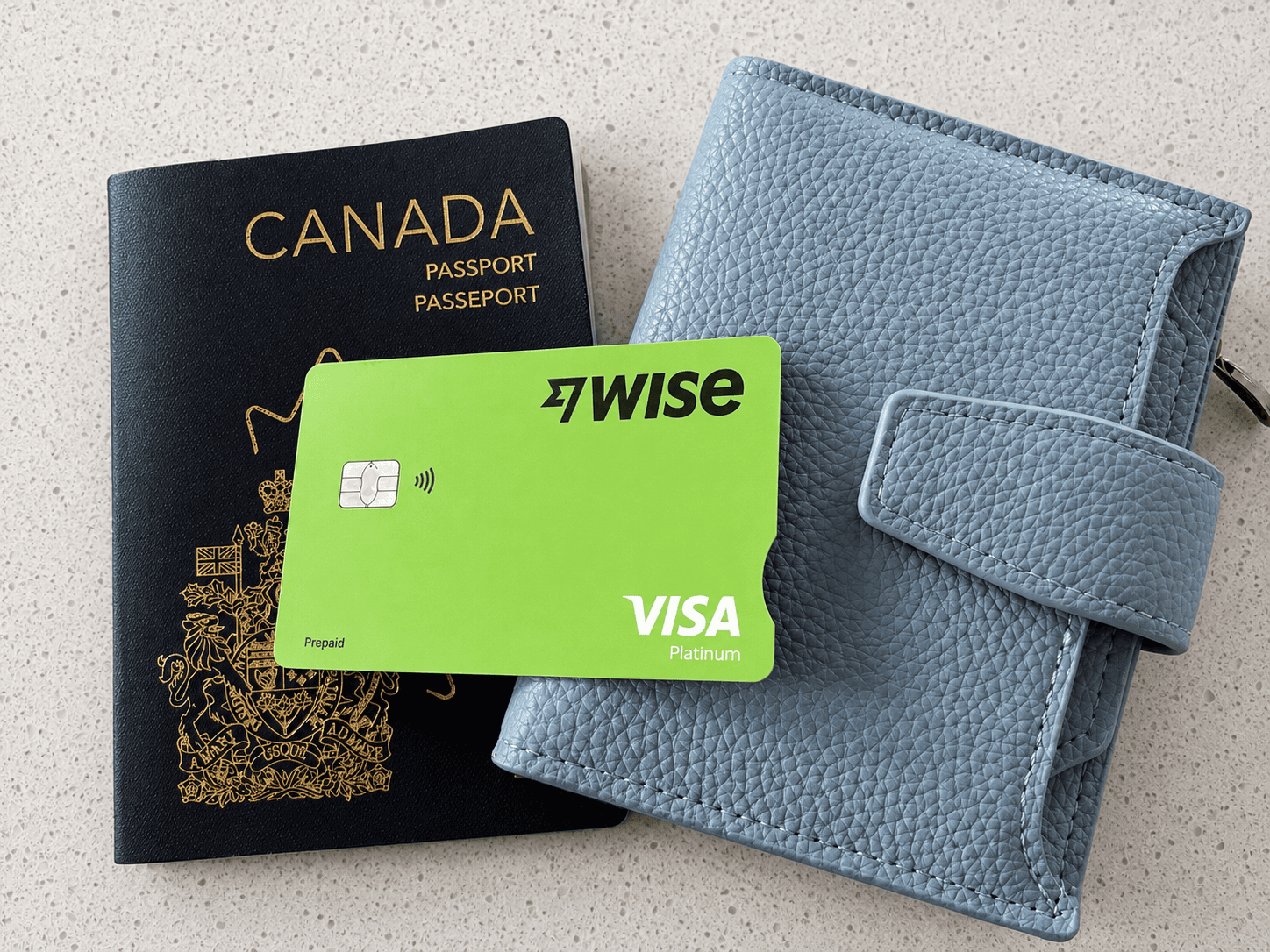
I signed up for Wise because I was tired of losing money every time I needed another currency. Exchanging cash before a trip rarely gave me anything close to the exchange rate I could see online, while using a regular Canadian credit card abroad added another layer of foreign-currency costs. I also did not want to travel with large amounts of cash simply because I needed access to local currency.
That became much more important when we started planning several months through Southeast Asia and Japan. Carrying enough cash for a trip that long was never going to be sensible, so I wanted a way to access money as we travelled rather than trying to predict our cash needs months in advance.
I found Wise while researching options used by other travellers and decided to test it before relying on it for a long trip. I used it first in Mexico, put it through a much more serious test in Italy, and have since used it from Canada to pay for flights, ferries and hotels in Thai baht.
So far, it has become my preferred way to handle many foreign-currency purchases when I do not need the rewards or insurance benefits of a regular credit card. I still travel with credit cards and still use cash where necessary; Wise simply gives me another, often cheaper, way to pay.
Affiliate disclosure: This article contains affiliate links. If you book or buy through one of them, I may earn a commission at no additional cost to you. This does not affect the recommendations or comparisons in the article.
See the current Wise account and card options.
What Wise actually does
Wise is a multi-currency account with a debit card attached. For Canadian customers, it currently allows you to hold and spend in more than 40 currencies. If you make a purchase in a currency you are not already holding, Wise can convert money automatically from another available balance.
Wise says it uses the mid-market exchange rate and charges a separate conversion fee rather than building an additional markup into the exchange rate. That was the distinction that interested me. I am not trying to time currency markets or optimize every fraction of a cent; I wanted a straightforward way to access foreign currencies without repeatedly accepting poor exchange rates.
I tested it before relying on it for a long trip
Mexico became my first experiment. The physical card had not arrived before departure — I remember delivery taking around 15 business days — but I could create a digital card immediately and add it to Apple Wallet.
I did not use it extensively because phone-based tap payments were not available everywhere I wanted to pay, but I successfully used it at the hotel for the tourist tax and again at the airport for snacks. It was enough to show that the basic system worked.
Italy became the real test. I used Wise for public transit in Rome and Naples, the Capri funicular, restaurants, attraction admissions and an ATM withdrawal. It worked everywhere I tried it, and I also deliberately topped up the account while abroad to make sure I could do that before relying on the same system for a much longer trip.
How I add money from Canada
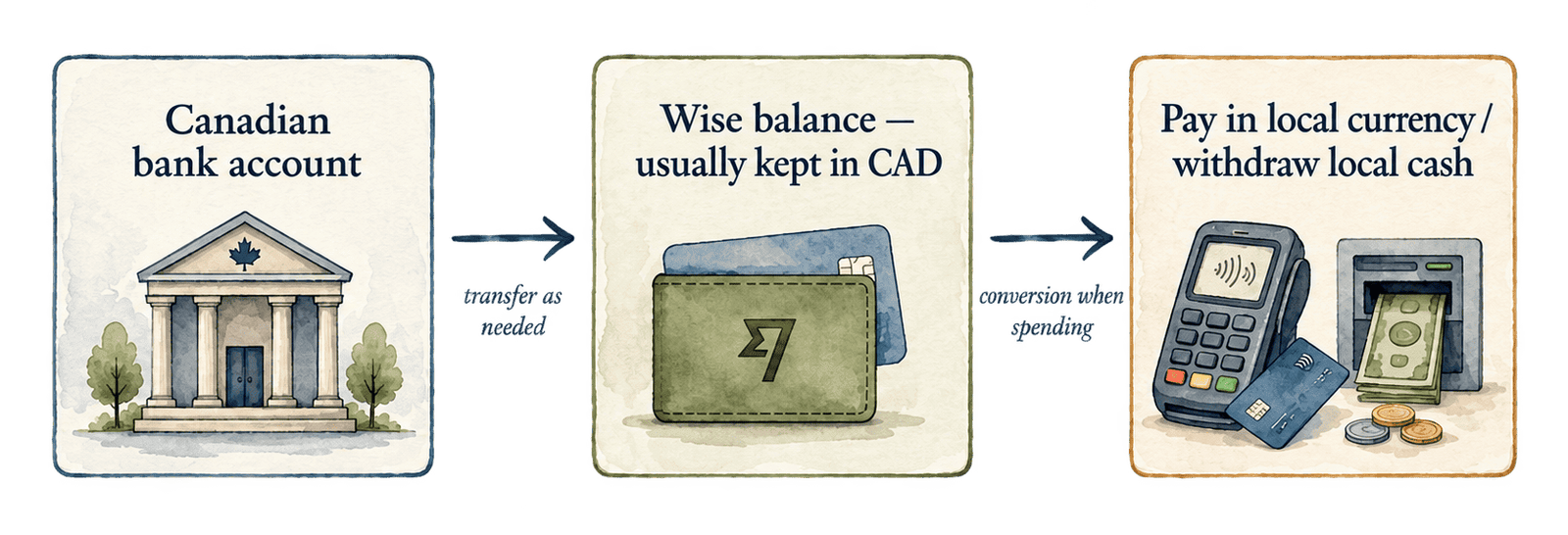
I connect my Canadian bank account through the Wise app and initiate transfers from there. In my experience, the money has appeared in Wise almost immediately and I have sometimes used it for a booking within minutes, even though the withdrawal from my Canadian bank account appeared a couple of business days later.
That is my experience rather than a guaranteed processing time, so I always make sure the money remains in the linked account until the transfer actually clears.
More importantly, topping up from Italy worked just as it did at home. That means I do not need to load months of travel spending onto Wise before leaving Canada. I can keep most of our money in our regular bank account and move smaller amounts as needed.
The bank connection does occasionally need to be reauthenticated. That is easy enough at home but worth planning for abroad because your bank may require multi-factor authentication, including a text to your Canadian number. If you plan to travel using eSIMs, make sure you still have a way to complete your normal Canadian banking authentication.
I also avoid moving money over public hotel, café or airport Wi-Fi, just as I would avoid logging into my regular bank account on those networks.
Why I usually leave the balance in Canadian dollars
Wise allows you to hold multiple currencies, but I generally leave my balance in CAD and let Wise perform the conversion when I spend.
That means I do not have to predict exactly how many euros or baht I will need and then potentially pay to convert unused money again later. It is possible to watch exchange rates and convert when they look favourable, but that is more optimization than I personally want to do.
For me, part of the appeal is not having to think about currency constantly.
Using Wise at an ATM
My ATM withdrawal in Italy was one of the most useful tests.
The machine offered to convert the transaction into Canadian dollars for me. I declined and chose to withdraw in euros instead, allowing Wise to perform the currency conversion. Wise recommends the same approach: when an ATM, store or website offers a home-currency conversion, choose the local currency instead.
At the ATM
Choose the amount in the local currency, not Canadian dollars, so the ATM does not perform its own currency converstion.
When I checked the exchange rate afterward, it compared extremely favourably with the market rate. A colleague travelling at the same time had exchanged cash another way, and the difference between what we had effectively paid for our euros was striking.
Current Wise ATM fees for Canadians
ATM fees are something I would always verify before travelling because Wise can change its pricing. At the time of writing, Wise says Canadian customers can withdraw a combined C$100 per calendar month without a Wise ATM withdrawal fee. Above that amount, the current Wise fee is C$2.69 plus 2.69% of the amount over the allowance. The ATM operator can also charge its own separate fee.
Wise pricing can change
These were the Canadian ATM fees checked when this article was written. Verify current Canadian pricing with Wise before relying on these amounts.
That affects how I think about cash withdrawals. Once you are beyond the free allowance, repeatedly taking out small amounts is unlikely to be efficient because you may be paying Wise's fixed fee as well as a local ATM fee each time. On a long trip, I will need to balance security — I still do not want to carry large amounts of cash — against avoiding unnecessary repeat withdrawal fees.
The best amount will depend on the country. In places where ATMs impose substantial local fees, making fewer, more deliberate withdrawals may make more sense than treating an ATM like one at home and taking out a small amount every few days.
Wise still does not replace cash
Even with Wise, I would not travel without some cash. On the Amalfi Coast, for example, I encountered local bus fares that needed to be paid in cash, and some small attractions and businesses either required cash or made it simpler.
The difference is that I no longer need to predict before departure exactly how much cash the entire trip will require. I can withdraw local currency when I need it and use Wise for the transactions where cards make sense.
Using Wise before I even reach Thailand
One of the more useful discoveries has been that Wise can help with trip costs before departure.
While planning Thailand, I have used it to pay Bundhaya directly for ferry tickets, Bangkok Airways for flights and Booking.com for hotel reservations when I could choose to be charged directly in Thai baht rather than accept a Canadian-dollar conversion.
That has made me pay much more attention to the currency shown at checkout. A Canadian-dollar price may look convenient, but if the merchant is doing the conversion itself, that does not necessarily make it the better rate.
My default now is to check whether I can pay in the merchant's local currency and let Wise handle the conversion instead.
Wise versus my Aeroplan credit card
Wise has not replaced my regular credit card because the two solve different problems.
My Aeroplan credit card earns points and includes travel-related insurance benefits that can matter for major purchases. I still use it for international flights and for hotel bookings where there is no meaningful advantage to paying directly in local currency.
When I use Wise instead, I am potentially giving up Aeroplan points in exchange for avoiding the foreign-currency costs associated with the credit card. For a small restaurant bill, the difference may be minor. For flights, hotels and months of international spending, it can become much more meaningful.
I am not currently trying to maximize every possible Aeroplan point, so I am comfortable making that trade-off more often. Someone trying to earn status or maximize credit-card rewards could reasonably reach a different conclusion.
Why I still carry backup cards
I would not rely on one card for a long international trip, even though Wise has worked reliably for me so far.
My husband now has his own Wise card, and we will carry regular credit cards as well. Within my own Wise account, I also have a digital card and a physical card available through Apple Wallet. The physical card remains important for ATM withdrawals, while the digital card provides another set of card details that can be useful if another card has to be frozen.
The goal is redundancy rather than finding one perfect payment method.
Wise
Best for: Many everyday foreign-currency purchases and some cash withdrawals.
Main advantage: Currency conversion is transparent and I can pay directly in local currency.
Trade-off: Conversion and ATM fees still exist, and I may give up credit-card rewards or protections.
Regular credit card
Best for: Purchases where rewards, insurance or purchase protections matter more.
Main advantage: Points, insurance and other card benefits.
Trade-off: Foreign-currency costs may make some international purchases more expensive.
Cash
Best for: Places where cards are not accepted or are impractical.
Main advantage: Still necessary in some situations.
Trade-off: It has to be obtained, carried securely and replenished as needed.
What I like — and what I would prepare for
The Wise app is straightforward, transaction notifications arrive quickly and adding money has been simple in my experience. I also appreciated getting access to a digital card before the physical card arrived.
The signup process itself takes more than a few minutes because Wise needs to verify your identity. I would do it on a phone, since you will need identification and photos as part of the process, and I would not wait until immediately before departure if you want the physical card.
The main inconvenience I have encountered is occasionally needing to reconnect my bank account. I understand the security rationale, but it reinforces the importance of maintaining access to whatever authentication your Canadian bank requires while travelling.
Wise also is not fee-free. Currency conversion carries a fee that varies depending on the currencies involved, and ATM fees can apply. What I prefer is being able to see those costs rather than having much of the expense hidden inside an exchange rate.
How I currently use them
Wise
Many foreign-currency purchases and access to local cash.
Credit card
Purchases where rewards, insurance or other protections are worth more to me.
Cash
Situations where cards are not accepted or are simply impractical.
Is Wise worth getting for travel?
For me, yes.
Even for a short trip, I like not having to exchange a large amount of cash in advance. I can pay directly in local currency, withdraw some cash after arriving and still keep a regular credit card available when its points or insurance benefits make it the better tool.
The case becomes much stronger for a long trip involving multiple currencies. For several months through Southeast Asia and Japan, I can keep most of our money in Canada, move funds into Wise as we need them, withdraw local cash and pay directly in local currencies without trying to predict the entire trip's spending before departure.
That does not make Wise the only card we will carry. It makes it part of a broader system: Wise for many foreign-currency transactions, credit cards where their rewards or protections matter more, and cash where cards simply do not work.
After testing it in Mexico, using it much more extensively in Italy and already paying for Thailand bookings with it, that is a system I am comfortable taking on the road.
See the current Wise account and card options for your trip.
Plan your own trip
Know How You Travel
Understand how pace, comfort and the number of hotel changes fit the way you travel.
Plan Your Trip
Build a route around the time, priorities and logistics that actually matter.