

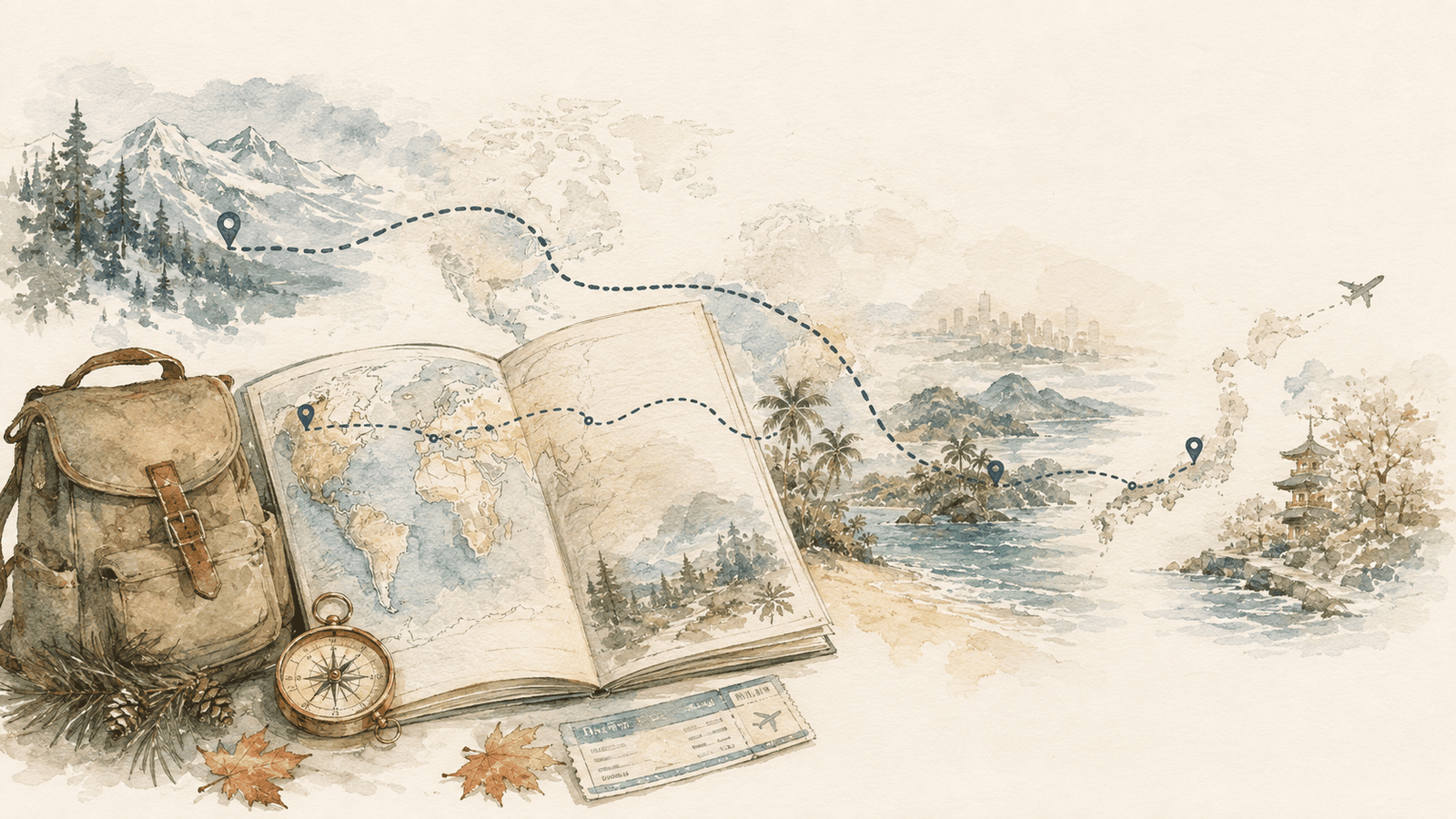
I have wanted to travel through Southeast Asia since I was in university.
At one point, I even bought a copy of Southeast Asia on a Shoestring and imagined doing the trip during a gap in my studies. It never happened. The timing was wrong, money was limited and co-op placements made it difficult to disappear for long.
But the idea never really went away.
Years later, my husband and I started talking about taking a sabbatical sometime in the middle of our careers. At first, the destination was not even the point. The appeal was simply having enough time to travel differently: not squeezing a faraway part of the world into two weeks, not spending half the trip adjusting to jet lag, and not feeling that every day had to justify the cost of getting there.
Then life got busy. We had children, careers progressed, and the trip started drifting toward something we might do in retirement.
Eventually, we realized we were treating retirement as though it were guaranteed.
We are healthy now. Our kids are at an age when taking them out of school for a period feels manageable. Our careers are established enough to accommodate a pause. There will always be reasons to wait, and there is no way to know what life will look like twenty years from now.
So about a year and a half ago, we started saving seriously for a winter 2027 departure.
Missing a Canadian winter did not hurt either.
Why several months instead of a shorter trip
Part of the appeal is simply having time.
Southeast Asia is a long way from Canada, and I never wanted to experience it only in a series of rushed two-week vacations. Four and a half months still will not let us see everything, but it gives us enough time to move more slowly while still experiencing a wide range of places.
It also gives us room for ordinary days.
We are not planning four and a half months of constant sightseeing. Some days will be spent homeschooling. Some will involve swimming in a pool, wandering around a neighbourhood, doing laundry or sitting in a café.
We have downtime at home, so it would make little sense to design a trip where downtime suddenly disappeared.
That slower rhythm matters even more travelling as a family. One substantial activity in a day is often enough. Arrival and departure days do not need to double as sightseeing marathons. Longer stays give us space to recover after moves and simply live somewhere for a few days rather than constantly passing through.
I also like the idea of having such a long stretch of time together. I once heard the reminder that you only get about eighteen summers with your children. However you count it, the underlying point stuck with me: this stage of family life is temporary too.
WHAT FOUR AND A HALF MONTHS GIVES US
More time
→ fewer rushed transitions
Longer stays
→ room for ordinary days
More flexibility
→ not every day needs to “produce” something
More variety
→ cities + nature + beaches + mountains
More trade-offs
→ still impossible to see everything
More family time
→ a different rhythm than home
Why Southeast Asia, and why Japan
Southeast Asia was always the heart of the idea.
I was drawn to the culture, food and landscapes, but also to the variety. Within one broader region, we can move between major cities, beaches, mountains, temples, islands, forests and very different cultures and languages.
It is also relatively affordable for a long trip. Transportation between countries can be inexpensive, accommodation offers a wide range of options, and the region makes it possible to travel comfortably for several months without requiring an unlimited budget.
This is no longer the backpacker budget I imagined in university, and I am thankful for that. We are willing to spend more when convenience meaningfully improves the trip, but we still have a budget and make choices within it.
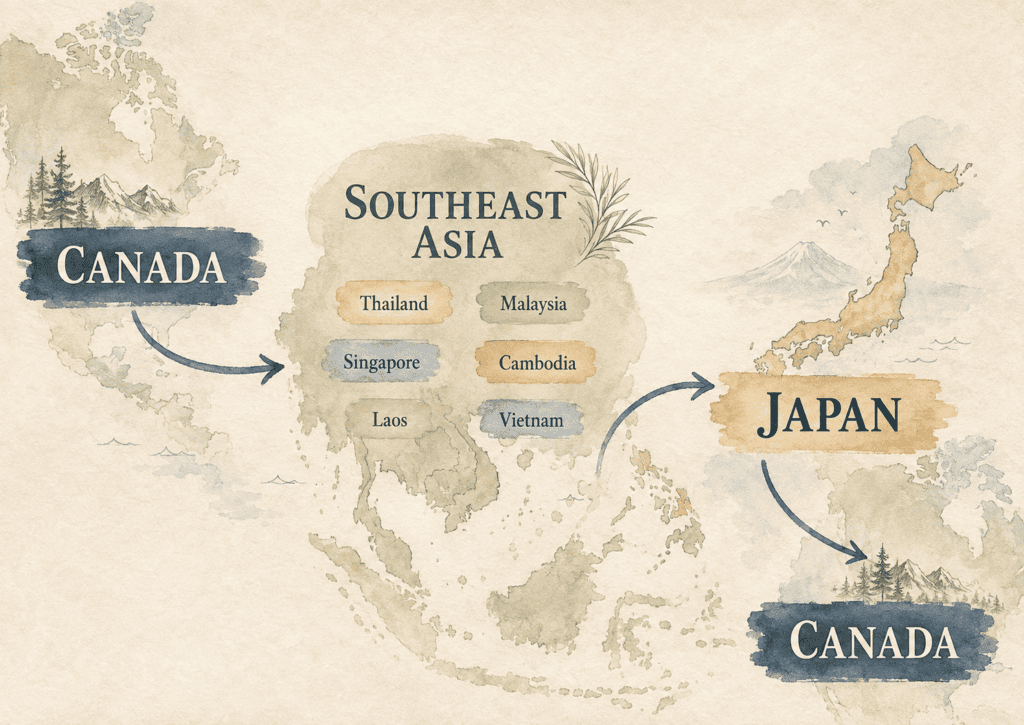
Japan was added later. Some family members had travelled there recently and came back raving about it, and ending the trip there also moves us ever so slightly closer to home. More importantly, it adds another very different culture and travel experience to the same journey.
We know we will not see everything
Even with four and a half months, there is no version of this trip where we see everything.
We will visit several countries, but not all of them. Myanmar, Indonesia and the Philippines are not part of this itinerary. Some countries will get much more time than others, while places such as Laos and Cambodia will only be relatively short stops.
That is not a failure of planning. It is simply the reality of travel.
Trying to see everything would probably make the trip worse.
We are deliberately balancing cities with nature, faster sections with slower ones, and major sightseeing days with days where almost nothing is scheduled. We are planning to book accommodation and important transportation in advance because that suits how I travel, while leaving much of the day-to-day experience open. Those choices are a good example of why I think it helps to understand how you travel before you start building an itinerary.
I am also not trying to optimize every dollar or hour.
Sometimes a flight is worth more than a very long overland journey. Sometimes a slightly more expensive hotel makes a difficult transition easier. Sometimes the best use of an afternoon will be doing absolutely nothing productive.
Those are all part of the trip too. Our Thailand itinerary is one example of how that thinking looks in practice: even with 26 nights, we deliberately left places out rather than turning the month into a race across the country.
What I hope the kids get from it
Travelling with children changes the trip, but one reason we are doing this now is because of what I hope they will absorb from it.
I want them to see that people live differently around the world. I want them exposed to different languages, cultures, food, religions, history and ways of organizing everyday life.
I hope they become more adaptable and patient.
I hope geography becomes something more tangible than a map and history becomes something they have walked through rather than only read about.
There are things a classroom does extremely well, but there are also things it cannot replicate. Standing in an ancient temple, navigating transportation in another language, seeing how another family lives or simply noticing how everyday routines change from country to country creates a different kind of learning.
And yes, I am also hoping they fall in love with the food.
What I hope to get from it
I have plenty of wanderlust to feed, but I also want a break from routine.
Work is busy. Life at home is busy. The world itself can sometimes feel complicated and heavy.
Travel does not make any of that disappear, but it can change the scale of things for a while. I am looking forward to having time for curiosity, introspection and experiences that are not organized around the normal calendar.
I also genuinely enjoy the planning. Researching routes, comparing trade-offs and figuring out how the pieces fit together has been part of the pleasure rather than simply a chore before departure.
In fact, that planning process eventually helped inspire Beyond the Photo Op. The trip came first. The idea to document some of what I was learning came later.
The parts that make me nervous
A long trip is not automatically easier because we have more time.
Homeschooling will be new. Being together almost constantly will be new. Moving frequently may turn out to be more tiring than it looks in a spreadsheet.
I sometimes wonder whether I have planned the pace correctly.
I wonder whether we will get homesick, miss our routines or simply miss having access to all our stuff. That last one may be a useful experiment in itself: four months of carrying relatively little is a good way to find out how much you actually need.
And strangely, I worry that four and a half months might feel too short at exactly the same time that I wonder whether we will be ready to come home.
There is also the slightly dangerous possibility that I discover I would rather keep travelling forever.
That particular mid-life crisis can wait.
What would make the trip a success
The success of this trip will not depend on whether we see every place on the itinerary.
I hope we come home feeling stronger as a family, with good memories of the time we spent together and a better understanding of how each of us travels.
I hope we learn something about ourselves individually and as a group.
And most of all, I hope our children come home with their world feeling a little larger than it did before we left — and with enough curiosity that they want to keep exploring it.
Planning a trip that fits you
- What Kind of Traveller Are You?
- How We Planned 26 Nights in Thailand Without Trying to See Everything
Plan your own trip
Know How You Travel
Understand how pace, comfort and the number of hotel changes fit the way you travel.
Plan Your Trip
Build a route around the time, priorities and logistics that actually matter.