

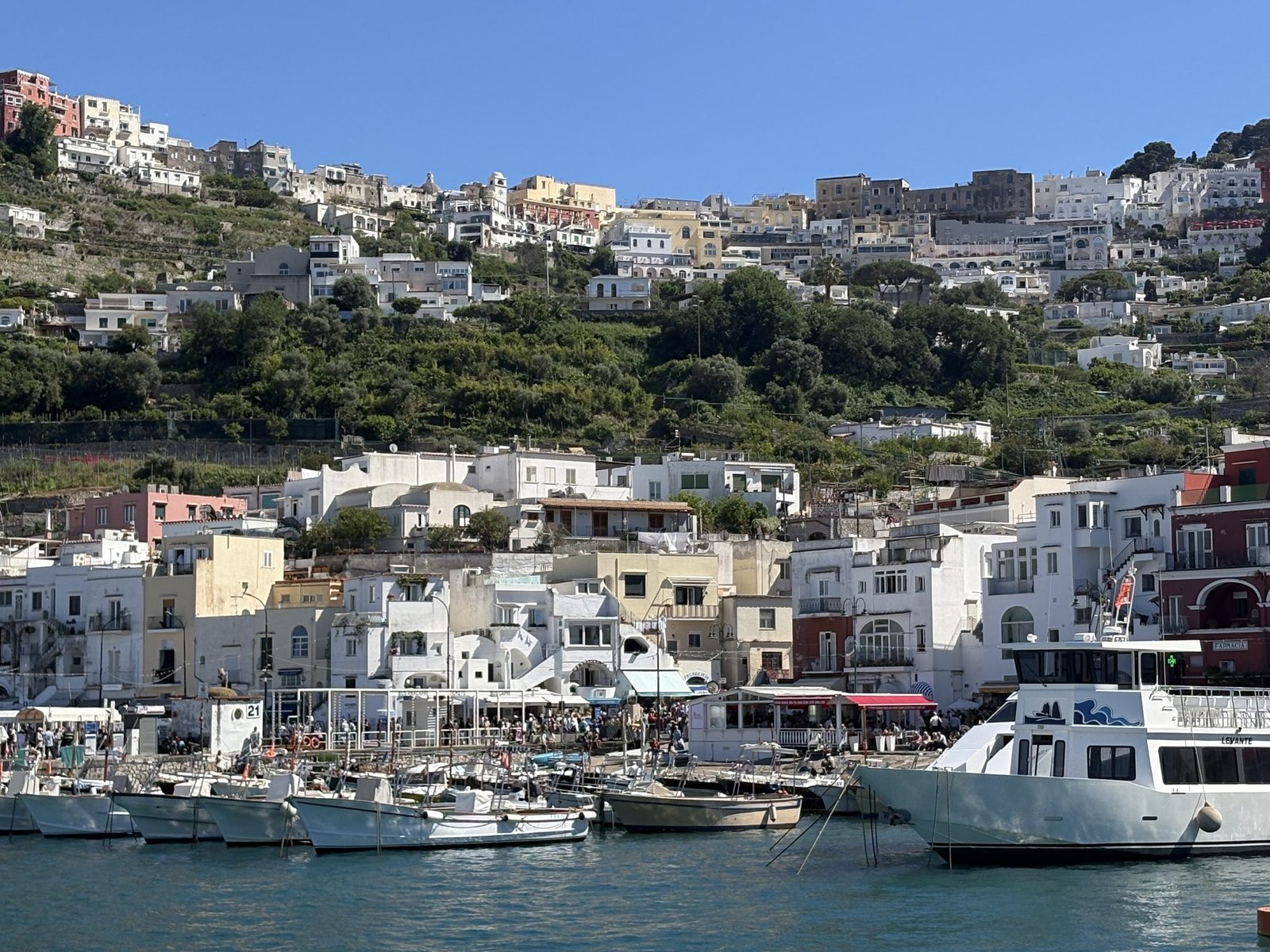
Travelling around Italy by train and ferry can look very simple when you build the route online. A high-speed train gets you into Naples, the metro connects to the port, and ferries link Capri and the Amalfi Coast.
In practice, the individual pieces were easy. The uncertainty came from what happened between them: a rail strike that remained unresolved until I was already in Italy, a rough ferry crossing that ran late, a cancelled port stop, and the fact that ferry schedules depend on conditions in a way train timetables do not.
On a four-night trip from Rome through Capri, Amalfi and Naples, I used Italo, the Naples metro and three ferry journeys. Everything ultimately worked, but the experience changed how I think about building transport connections in Italy. The main lesson was not to plan for perfection. It was to book the important pieces, check the most reliable sources, understand what could go wrong and leave enough room that one disruption does not derail the whole day.
The route I travelled
My transport sequence was:
EXPERIENCED IN MAY 2026
Train: Rome → Napoli Centrale — Italo
Metro: Napoli Centrale → Municipio
Walk: Municipio → Molo Beverello
Ferry: Naples → Capri — NLG
Ferry: Capri → Amalfi — NLG
Ferry: Amalfi → Naples — Positano Jet
I travelled with a small roller suitcase and a daypack, which made the transfers much easier. Larger luggage would not make this route impossible, but it would add friction every time you switch between train, metro, walking and ferry.
The sequencing itself was deliberate. I explain the broader reasoning in How I Planned Four Nights Across Capri, the Amalfi Coast and Naples, but one important consideration was getting off Capri and back onto the mainland well before my flight home.
Booking the Rome-to-Naples train
I travelled from Rome to Naples on Italo and booked directly with the company on March 21 for a May trip. My Prima Business ticket cost €38.90 for a scheduled 9:41 a.m. departure from Rome and 10:53 a.m. arrival at Napoli Centrale.
Booking early gave me a reasonable fare and allowed me to travel in business class. At the time, there was no indication that my travel date would become complicated. Then, while researching the trip, I started seeing posts about a national transport strike planned for May 16.
That was when a straightforward train booking became something I had to keep monitoring.
Check the official Italian strike database
For transport strikes in Italy, the source I would bookmark is the official Italian Ministry of Infrastructure and Transport strike database:
Check current Italian transport strikes
The database lists scheduled strikes by date and transport sector and proved much more useful than relying on forum discussions or summaries generated from older information.
Check before you travel
Strike status, guaranteed train lists, ferry schedules and departure points can change. This trip was taken in May 2026; verify current information with the relevant official operator or government source.
In my case, the strike was still a live possibility when I was already in Italy. I was coming up with contingencies almost until the last moment because the guaranteed-train information would only become useful very close to the travel date.
Rather than immediately cancelling or rebooking, I looked at my exact Italo train number and found an older guaranteed-service list from a previous strike. My train had appeared on that list before, partly because its journey originated farther north and began during an earlier protected period. That did not guarantee it would run this time, but it gave me enough reason not to panic and start dismantling an itinerary in which I had very little flexibility anyway.
The strike was eventually called off while I was in Italy and moved to another date. I was very glad I had waited. Travellers who had completely rearranged their plans in response to the original strike risked finding themselves dealing with the rescheduled disruption instead.
It was a useful challenge to my planner instinct: sometimes the better planning decision is to wait for reliable information rather than solving a problem that has not actually happened yet.
Planner lesson
Once you know which official source to monitor, more speculation does not necessarily create better information.
For anyone prone to travel anxiety, I would also be selective about how much forum reading you do once you already know a potential strike exists. Repeated speculative posts — and AI-generated answers relying on information that may no longer be current — can create far more stress than useful information. Once I knew what to monitor, the official source mattered more than another twenty opinions about what might happen.
A strike notice does not automatically tell you whether your train will run
Italian rail operators may publish lists of specific guaranteed trains that operate during a strike. Those lists generally identify services by train number, origin and destination, which means the train number matters more than simply looking at the portion of the route you are travelling.
If you are boarding in Rome, for example, your train may actually have started somewhere much farther north. Looking only for information about “Rome to Naples” could therefore miss something relevant to the full service.
My previous guaranteed-list research gave me some reassurance, but I would never treat an old list as proof that a train will run during a future strike. It was simply one useful clue while I waited for the current information.
Getting from Napoli Centrale to Molo Beverello
Once I reached Napoli Centrale, the transfer to the port was straightforward. I followed the M signs for the metro and travelled to Municipio, which took about five minutes and cost €1.50. I tapped my Wise card directly to enter, one of several everyday uses I cover in Using Wise for Travel: How It Works and How I Actually Use It.
From Municipio, I followed signs toward the port and used Google Maps as a second check. The walk to Molo Beverello took roughly ten minutes, was flat and was easy with a roller suitcase.
One useful visual clue is what not to follow: the giant cruise ships. I walked past that area toward the ferry terminal shown around Naples Beverello/Molo Beverello on Google Maps. Always check the departure point listed on your own ticket, because Naples has multiple port areas.
What Molo Beverello was actually like
Inside the terminal were ticket counters, bathrooms, a small café, benches and electronic departure signs. The boarding process itself was a little less polished.
Passengers were gathering near the doors and forming lines as ferry departures approached. An attendant checked my e-ticket and luggage and handed me a small paper boarding slip. My booked ferry was the 11:55 a.m. departure, but the paper I was handed showed 11:35. A couple of other passengers had papers with the same time, while most appeared to have 11:55 slips.
I briefly considered leaving the line to ask for a replacement, but passengers were already gathering for the 11:55 ferry and I could not see a separate 11:35 boarding process underway. I also still had my original e-ticket on my phone if I needed to prove what I had booked, so I stayed where I was.
That was the right decision. The crew collected the small paper slip when I boarded, and that was what actually got me onto the boat. In this case, my e-ticket mattered because it was what I had shown to obtain that boarding slip.
Why I would leave about an hour between train and ferry
My Italo train was scheduled to arrive at 10:53 a.m. and my NLG ferry to Capri departed at 11:55 a.m., giving me just over an hour.
For this particular connection, that felt right. There had been an earlier ferry at about 11:35 a.m., and before travelling I had wondered whether I could make it. Once I actually arrived, took the metro, walked to the port, used the bathroom and figured out the boarding process, I remember thinking very clearly that I would not have made the earlier departure comfortably. By the time I reached Molo Beverello, passengers were already gathering for my 11:55 ferry.
I would not recommend trying to move faster simply because the timetable technically makes a tighter connection possible. The purpose of a buffer is to absorb the normal friction of travel, not to prove that a transfer can be done at maximum speed.
My starting point
Napoli Centrale → Molo Beverello → ferry
About 1 hour minimum between scheduled train arrival and ferry departure.
Add more time if:
- the ferry is especially important;
- you have larger luggage;
- you are travelling with children or anyone who needs more transfer time;
- disruption is already likely;
- missing the ferry would have major consequences.
For Napoli Centrale to Molo Beverello, I would personally use about an hour as a reasonable starting point and add more if the ferry were particularly important, if I had substantial luggage, or if I were travelling with people who needed more time to make the transfer.
Ferries introduce a different kind of uncertainty
My Naples-to-Capri ferry was scheduled to take about an hour, but the sea conditions were extremely rough.
As we boarded, staff were handing passengers seasickness bags and actively encouraging everyone to take one. At first I assumed this was standard procedure. It quickly became obvious that it was not.
A large number of passengers became sick during the crossing — possibly close to half the boat — and staff spent much of the journey helping people and trying to keep everyone updated. A few passengers had to be taken outside, and the crossing took longer than scheduled because of the waves.
If the crew is proactively handing out seasickness bags and telling you to take one, I would take it.
I was fortunate not to get sick. I sat by a window and kept my eyes on the horizon, something I knew from previous boating experience could help when the boat is moving unpredictably. I would also avoid staring at a phone or at the onboard screen showing the view from the front of the boat during a rough crossing.
This was very clearly the exception rather than my normal ferry experience. On my later Capri-to-Amalfi and Amalfi-to-Naples trips, I did not notice anyone becoming seasick, and both crossings felt dramatically calmer.
I had also intentionally left my first afternoon in Capri relatively open, so arriving later did not create another problem. That flexibility is one reason the overnight stay worked well for me, which I discuss more fully in Is Staying Overnight in Capri Worth It?
Think about how your luggage is stored
Luggage arrangements varied between the ferries I used. On the larger Naples-to-Capri boat, anything larger than a daypack was left toward the rear of the vessel rather than beside your seat, so I could not see my roller suitcase during the crossing.
Because of the rough conditions, the outside of my suitcase was wet with seawater when I collected it. Everything inside was fine, but it made me think differently about ferry packing. A hard-shell or more water-resistant suitcase could be useful, and anything particularly vulnerable to water should be protected inside your luggage.
On my later ferries, bags were stored inside toward the rear of the cabin, so do not assume every boat will handle luggage in exactly the same way.
Boarding in Capri worked differently
At the Capri port, electronic screens showed which numbered area passengers should use for each ferry. I arrived early enough to find the right section and watch the boarding process before my boat arrived.
This time, I did not need to exchange my electronic ticket for a paper boarding slip. Staff simply scanned the QR code on my phone. Other passengers had paper tickets they had apparently bought locally.
That reinforced a practical lesson from the trip: do not assume the process will be identical at every port. Give yourself enough time to check the screens, find the correct queue and ask if something is unclear.
Capri to Amalfi: your route can change after departure
My ferry from Capri to Amalfi was supposed to stop in Positano first. Passengers only learned after we were underway that the Positano stop had been cancelled.
Some travellers onboard had tickets specifically for Positano, and they were understandably upset. There did not appear to be an immediate replacement arranged onboard, and there was discussion about whether they would need to find another boat or continue by bus after reaching Amalfi.
When we eventually reached Amalfi, the captain's decision made considerably more sense. Even in Amalfi's more protected harbour, it took three or four attempts to dock because of the wind. Positano's ferry landing is much more exposed.
The important planning lesson is that a ferry ticket cannot guarantee the exact route in the same way a timetable makes it appear. Weather can affect not only the journey time but whether a scheduled port stop is possible at all.
Amalfi to Naples: same-day booking worked for me
For my final ferry from Amalfi back to Naples, I had considered booking Positano Jet in advance. A woman at the Amalfi ticket booth advised me that buying it that morning should be fine, so I followed her advice and purchased the ticket shortly before departure.
It worked smoothly. The boarding area used signs and separate queues for different ferries, although it still felt somewhat chaotic when several boats were arriving and boarding at once. There were moments of wondering why another line was moving while mine was not, or whether the approaching ferry was the right one, but getting into the correct line a little early meant I could see the boats and hear what staff were saying.
That crossing back to Naples was much calmer than my first ferry. The luggage was stored inside, nobody around me appeared seasick, and I could close my eyes and listen to a podcast rather than concentrating on the horizon.
Ferry strikes are worth checking too
Rail was not the only possible strike I encountered. There was also a maritime strike listed around the time I was travelling on the Amalfi Coast, which was not especially reassuring after already dealing with the uncertainty around the train.
I contacted my hotel in Capri and asked whether they had any local information. Their response was essentially that ferry service would continue and that I should book with one of the major operators. I decided to trust that advice and keep the itinerary while continuing to monitor the official Ministry strike database.
Because that same database includes maritime transport, I would use it for both rail and ferry disruption checks. As with the train strike, dates and status can change while older forum discussions and search results continue circulating as though nothing has happened.
How much buffer would I leave?
I would not turn one trip into a universal rule, but the experience gave me a useful starting point.
For a high-speed train arriving at Napoli Centrale followed by a ferry from Molo Beverello, I would personally allow around an hour at minimum. For a ferry arriving in Naples followed by a train, I would use at least a similar margin and would be inclined to add more because ferry arrival times can be affected by weather.
A ferry followed by an international flight deserves more caution, but I would not prescribe a universal number of hours. The answer depends on the port, airport, season, weather and what alternatives exist if the boat is delayed or cancelled. The more useful question is: what happens if this ferry does not run?
Why Capri came first in my route
That question was one reason I deliberately put Capri near the beginning of my four-night route rather than immediately before my flight home.
If severe weather stopped ferries from leaving Capri, I could potentially be stuck on the island temporarily. By travelling Capri → Amalfi → Naples, I moved back onto the mainland well before my flight.
Once in Amalfi, a cancelled ferry would still have been inconvenient, but there were potential overland alternatives through places such as Salerno or Sorrento. That is very different from relying on a ferry off Capri as your only connection before an important international flight.
This sequencing was part of the broader logic behind the trip, which I explain in How I Planned Four Nights Across Capri, the Amalfi Coast and Naples.
Plan the route, then leave room for reality
The biggest lesson from these few days was not that Italian transport is unreliable. Most of my journeys ultimately worked close enough to plan.
What changed was my understanding of how much uncertainty can sit around a carefully researched itinerary. A strike can remain unresolved until almost the last moment. A ferry can run late because of waves. A captain can skip a port. An online discussion can keep telling you there is a crisis after the official situation has already changed.
My instinct as a planner is to solve problems early. In this case, staying calm and waiting for reliable information was the better decision. I am glad I did not start rebuilding the Rome-to-Naples connection around a strike that was eventually called off and moved, and I am equally glad I did not try to squeeze myself onto the earlier Capri ferry simply because the timetable suggested it might be possible.
For future train-and-ferry travel in Italy, I would use the same approach: research the route carefully, check official disruption sources, leave realistic margins and understand what the backup options are.
Then stop trying to control every possibility and let the trip happen.
More from this trip
- How I Planned Four Nights Across Capri, the Amalfi Coast and Naples
- Is Staying Overnight in Capri Worth It?
- How to Hike the Path of the Gods from Amalfi
- Why I Chose Amalfi Town as My Base
Plan your own trip
Know How You Travel
Understand how pace, comfort and the number of hotel changes fit the way you travel.
Plan Your Trip
Build a route around the time, priorities and logistics that actually matter.
Explore more of Italy
Planning more of Italy? Explore our firsthand articles and practical advice from Rome, Capri, the Amalfi Coast and Naples.